I had put myself in an awkward position. No—literally. Forced to recline at an odd angle because our loveseat’s a bit too small for both me and Calvin to stretch out, my view was the back of a whiteboard Calvin uses for studying. One side listed several meds he needed to memorize for school; the other side was a verse.
I had just come home late again, tired physically, but mostly emotionally. I had prayed out loud on the way home (something I do a lot), talking to Jesus about His plans and purposes for my life, telling Him how thankful I am to be a sheep in the pasture of a Good Shepherd.
Now I was squished on the cramped couch, staring up at the verse on the back of whiteboard:
“Know that the Lord is God. It is he who made us and we are his; we are his people, the sheep of his pasture.” (Psalm 100:3).
There’s no way I would have seen the verse had I not been so exhausted I had to lie on the couch. There’s also no way I would have seen it had I not been in an uncomfortable position.
Friend, this is the goodness of God. Not that my situation always changes or that I get exactly what I’m praying for the moment I ask, but that I get Jesus for my situation—the presence and the peace and friendship of the One who knows and loves me. I don’t chalk up things like reading the very verse from which my prayers were born to coincidence. Doing so would be like saying my husband bringing home my favorite flowers on my birthday is a coincidence.
The more I walk and talk and just sit with him, the more I learn that Jesus is personal, and that relationship with Him is not solely a life of sacrifice and suffering. There most definitely is sacrifice and suffering involved—required, even—but there is also sweetness. There is also beauty. There is also the fullness of joy. Even if my situation doesn’t change and the rain doesn’t come in a year of drought, I still get all of Jesus to sustain me.
“But blessed is the one who trusts in the Lord, whose confidence is in him.
My dad read a few book series aloud to me when I was a kid,but my favorite was Anne of Green Gables. I remember when Anne Shirley asked for a dress with puffed sleeves, a part of my little heart jumped up to say, “me too!”
I’ve liked clothes for as long as I can remember. As a kid, I would spend afternoons on the floor of my mom’s closet, admiring the patterns and textures of the beautiful dresses that hung there. Ten years of consistent community theater participation also gave me an appreciation for the importance of costume design in painting a complete picture of a character.
When characters from favorite stories captured my heart, I longed to wear patterns, textures, and silhouettes that resembled them. I remember wanting to wear a yellow dress for my 8th grade graduation so I could match Luna Lovegood’s Deathly Hallows wedding guest gown from the book. The specific shade of yellow I wanted was hard to come by in 2010, and I ended up hobbling to the stage on crutches with my newly sprained ankle in Bella Swan’s green taffeta dress from New Moon. When it’s warm out, I still throw on a tomato-red plisse number that reminds me of Buttercup in the Fire Swamp.
When I entered my teenage years, I battled with how clothing also signified identity and status. For example, when the charter school I had enrolled in for 7th grade banned branded clothing from its dress code, I flung myself onto my bed and cried. How else would everyone know that I was a poser-surfer without my embossed Hollister sweatshirts?
Oh dear.
Then there were the well-meaning Christian bloggers and their long lists. The conversation then was generally around what not to wear; rarely did anyone bring up the art and the joy of dressing beautifully and appropriately for the setting and activity. In my teens, my own legalism kept me from wearing makeup and leggings, even in situations where it was completely appropriate to do so. I call these bloggers well-meaning because I do believe they were trying to give young Christian women guidance in a grey area, but their teaching was often narrow and legalistic.
Legalism seeks to keep the believer safe from sinning by putting words in God’s mouth, but leaves little room for discernment through actual relationship with Jesus. So while one might seek to honor God with how they dress, devoid of the conviction and communion of the Holy Spirit necessary for discernment, they can still be acting in legalism.
I still do value modesty, but I see it now as a heart posture of reverence and humility before God, rather than a long list of dos and don’ts or a specific length of hem.
Not the main character: the concept of the daily costume
These days I see clothes as one-part creative outlet and one-part daily costume. The difference between costuming a character and dressing myself is that I bring the day ahead to the Lord and ask who He needs me to be at this moment in His story. In one sense, I am a character in the story, but I know I am not the main character. That’s important.
The conversation goes a bit like this:
“Jesus, what do I need to do today? And who have you made me to be? How do I reflect that?”
Maybe it sounds weird, but through this perspective, I feel like I finally live in clothing freedom, no longer using clothes to define my identity, but instead to express it in a way that is useful, creative, and (hopefully) reflective of who I am in Christ. It’s not rooted in striving or shame, but in meaning and security. It’s not derived from the clothes I wear, but rather from the grace Jesus has clothed me in (Isaiah 61:10).
Here’s how I choose outfits:
I ask myself what the plan is for the day. When I was teaching high school, I adhered to a business-casual dress code. Most people loosely interpreted this to mean no jeans and sneakers unless it was Friday. Now that I get to work in ministry, my range of choices is much broader. If I’m writing check requests in the office, a comfy dress just is fine, but if I’m painting a backdrop for the high school room or playing a muddy group game, I need something more rugged. Though I try to be practical, my choices can still be somewhat tailored to my style preferences.
I check the weather. Because duh.
I delight in beauty as a form of worship. Once I’ve determined an outfit “type,” I can move on and think about what I like. Which patterns am I drawn to? What historical moment would be fun to channel today? I am a self-proclaimed fashion history nerd! This is the personal style element that makes getting dressed fun for me. Lately I’ve been enjoying bright colors. Years ago, I wouldn’t be caught dead in baby yellow or pink, but now I embrace how these colors make me feel and worship God as I think of the joy color brings me! To delight in beauty and attribute it to the Lord is a form of worship I think we all need in our lives.
I remind myself that I serve Jesus. Modesty-culture wounded so many with arbitrary rules. While I no longer agree with many of the bloggers I learned from in my teens, I still strive to serve Jesus with my outward appearance. I think the key determiner between legalism, moral relativism, and freedom in this area comes down to who I am really trying to please. If I wear whatever I want with no regard for anyone else because I have the “freedom” to do so, I am probably not putting Christ first (see 1 Peter 2:16). On the other hand, I could also be piling on unnecessary rules for myself and others if I leave Jesus out of the conversation. For example, I might make up a rule about avoiding the color red because of its association with lust (yes, I’ve heard this one 😆) and distort the actual gospel, which says NOTHING about avoiding this color. I’ve found that it actually takes more effort to invite the Holy Spirit into the equation than it does to just rule out pants or mascara. Anyway, all this to say that I try to make sure I am dressed appropriately for the occasion, and I ask the Holy Spirit to convict me if my motives are off. It’s simple, but it does require relationship with Christ to be at the forefront. I do think He cares about what I wear, but Jesus cares most about the inner workings of my heart (1 Samuel 16:7).
Personal inspiration
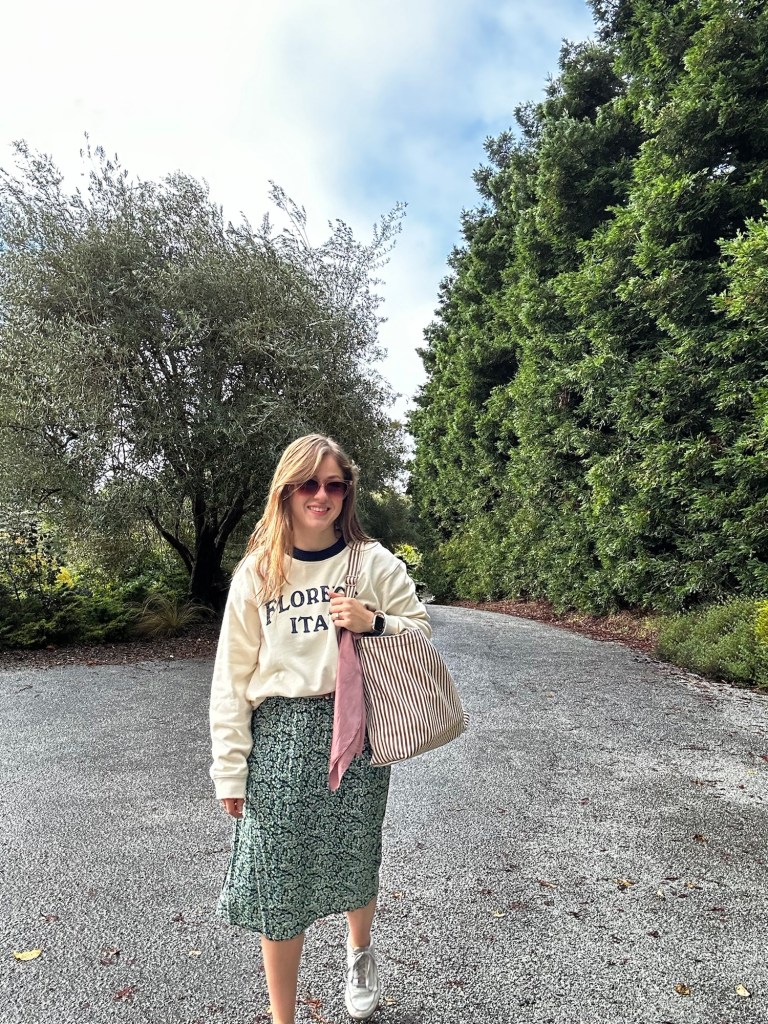
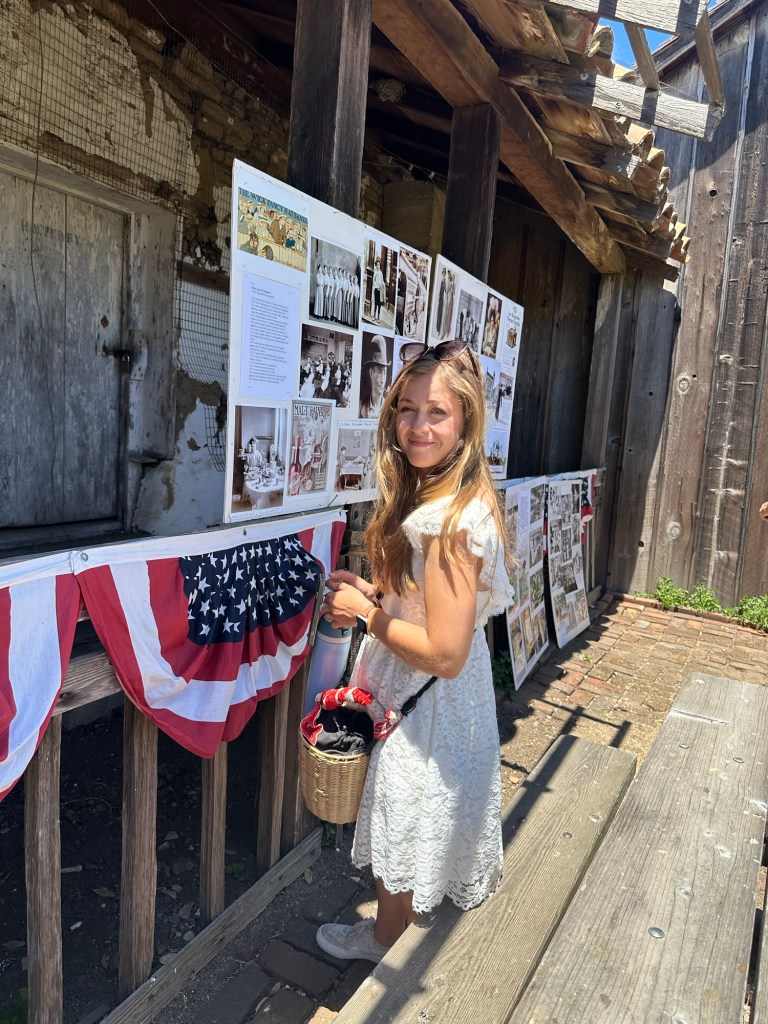
I gravitate toward spring colors, rustic textures, knits, delicate lace, and anything that reminds me of literary characters I love. I especially like overalls (give me all the pockets), midi dresses, crop sweaters (very versatile when you’re petite), quilted fabric, and embroidery!
I thought I could also include a few of my favorite outfit formulas. Consider these my uniforms.
A few example uniforms
Dress and sweater combo:
Dresses and skirts with t-shirts or on their own:
Overalls:
Fun jacket:
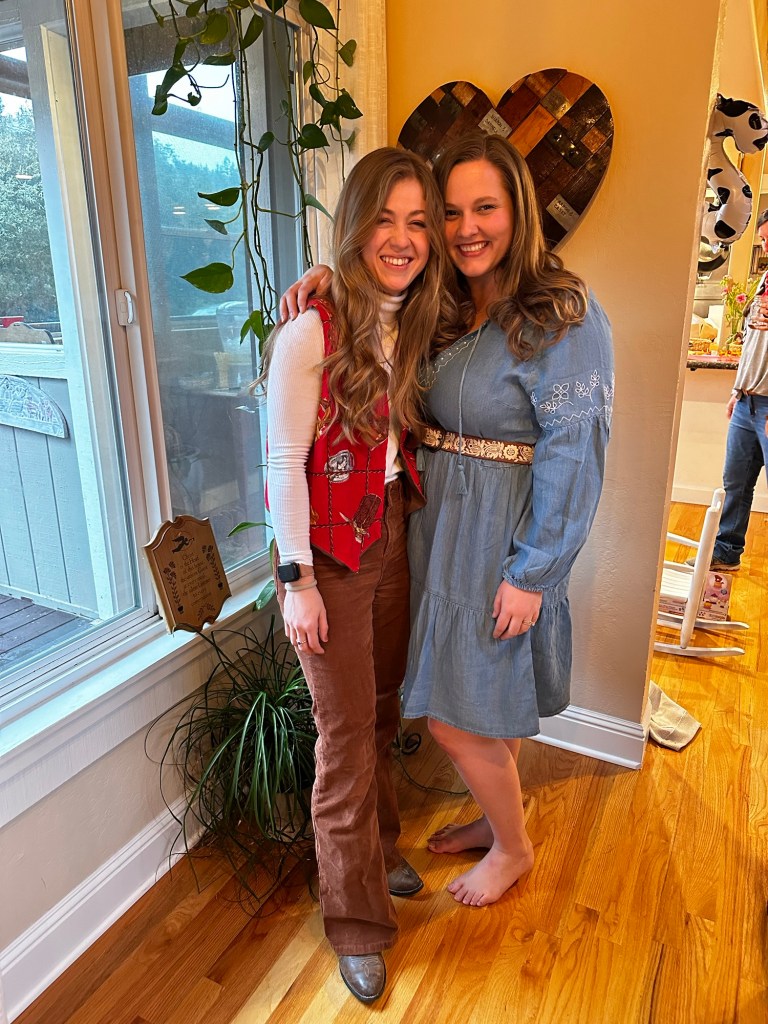
Western details:
This was technically a theme party, but all of the pieces are totally wearable separately!
Freedom and fun
Fashion is one freedom issue that has long been a source of pain in the church, particularly for women. It doesn’t have to be. When we seek God for discernment, we can still delight in beautiful things, living out the good works He has set before us with freedom and joy.
I am not the main character. Thank goodness that Jesus is! But I am a beloved part of the story—a story of the lost getting found, of those under the law coming under grace, and of those living in ashes being given an inheritance of everlasting beauty and joy.
I want to tell it well, to be clothed first and foremost in Jesus, and to point to the Savior of the story with all of me, even with the clothes that I wear.
“I delight greatly in the LORD; my soul rejoices in my God. For he has clothed me with garments of salvation and arrayed me in a robe of his righteousness, as a bridegroom adorns his head like a priest, and as a bride adorns herself with her jewels.” (Isaiah 61:10)
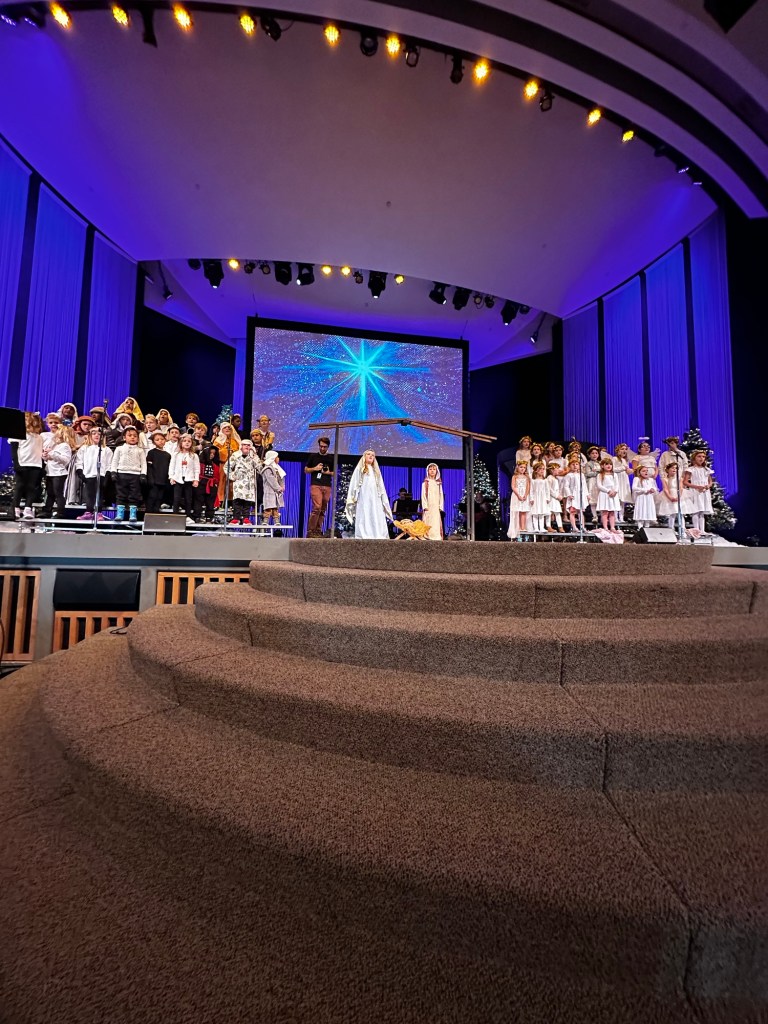
The littlest shepherd in the front row tilted his head as his pillowcase head covering fell over his eyes…again. Angels in garland halos sang while a 5 year-old Mary carefully rocked the Jesus doll. It was a chaotic, adorable scene, and the congregation was delighted.
I sat on the floor in the front row, trying to help the kids with their cues. When the song “Away in a Manger” came on, however, a familiar line removed me from the moment:
“The little Lord Jesus, no crying he makes.”
Really? The baby Jesus didn’t cry? Whoever wrote this poem must have never flown in economy. There’s an implication that comes with this idea that the baby Jesus didn’t cry—that Jesus wasn’t totally human. And while I’m sure the author was just trying to complete the rhyme, it makes me wonder how it affects us when we forget the humanity of Jesus.
Credits go to Pastor Rene for capturing myself, Elizabeth, and Yolanda all trying to get the kids to smile, sing, and stop whacking each other with their shepherd’s crooks.
There’s a name for this doctrine: the hypostatic union, which describes the dual nature of Christ. It means Jesus was both fully God and fully man.
This doctrine doesn’t simply make me feel better about myself in that, in my humanity I have put myself closer to Jesus. It means that He has intentionally, and at great cost to himself, put himself closer to me.
It means that when I was highlighting scripts for the narrators an hour before the Christmas Pageant started, crying behind a music stand because my mom has a terrible disease I cannot heal, Jesus was close to me.
The truth is that Little Lord Jesus did not stay little. He grew. He became a man called the “man of sorrows” and one “well acquainted with grief” (Isaiah 53:3). In taking on humanity, Jesus did not save himself from suffering. He didn’t rescue himself from the cross, but went there willingly out of love for us. For you.
Glossy images of a soundly sleeping baby in a serene stable (it was most likely a cave) probably do not accurately depict the first Christmas, and thank God! The scene of the first Christmas was more than likely a mess, much like the world Jesus entered into to redeem.
So to you who shed tears this year, remember Jesus, both in the manger and on the cross. The God-man who wept understands and stays near (Hebrews 4:15). He has given the ultimate gift. And one day, when we are fully in his embrace again, we won’t cry anymore (Revelation 21:4).
I used to think experiencing Jesus took place only in solitude. I had no problem with seeking Him in the early hours of the morning, armed with my coffee and a little notebook and whatever questions I had to ask Him. But whenever it came time to gather with a congregation, for example, I just didn’t know how to engage. I took the “my Jesus, my Savior” lines from Darlene Zschech’s “Shout to the Lord” to mean, “my Jesus, and only mine; what can’t it just be us in heaven??”
To be honest, I didn’t like to have to share my Jesus with other people, and the idea of opening up about my faith to someone who could so easily pick it apart made me squirm. For a long, long time, my heart, and therefore my faith, was a private affair and I liked it that way.
It took years of trying and failing, trusting, hoping, being disappointed, yet still finding the courage to try again to learn that there are still priceless treasures to be found in the raw and messy business of friendship.
Take my dear friend, Daryl, for example. We started out as teaching partners—one room apart in the English Department hallway, decades apart in age. I have never known and been known as well as I am by this friend. It’s a tremendous gift that with her, I am safe to absolutely lay my heart bare, no matter what. And it’s not because she is perfect (although some days I kinda do think she is), but because she really loves me with the love of Jesus.
We have wept together and laughed so hard we couldn’t breathe. We’ve graded papers and done laundry together. We share a love of plants and stories and little animals and British humor. At the center of it all is Jesus: His beauty, His truth, His love. Yes, I do experience Jesus in solitude, but I also enjoy Jesus when I am with this friend.
We are a lonely society keen on making every part of our lives public EXCEPT for the very most important parts of us: our real selves. And I get it. Humans will disappoint us. They will hurt us at one point or another. And the inner parts of us shouldn’t be made available to just anyone.
However, I still think it’s worth the risk to find people who will protect, and even sometimes gently correct you because they truly love you. It’s why the Psalmist writes that, “faithful are the wounds of a friend” (Proverbs 27:6a). Someone who is just in it for vibes and good times can’t do that, and someone who is not interested in true friendship as Jesus describes it won’t be ready for that level of sacrifice and accountability.
I think that’s the beauty of real, Christian friendship. It’s not just about feeling good about ourselves. It’s not just about not being alone. Jesus himself describes true friendship as the act of laying one’s life down for someone else. In a stunning reveal, he explains that that was what he came to earth to do, saying, “Greater love has no one than this, that someone lay down his life for his friends” (John 15:13).
Friendship on this side of Heaven is not perfect, but it can be good, and it’s worth the mess, the mistakes, and the time it sometimes takes to find a good fit. Because a friend who will love you, truly love you with the selfless love of Jesus, is worth all the treasure in the world.
🌸🌸🌸
Some verses to help you further explore the topic:
Proverbs 17:17 “A friend loves at all times, and a brother is born for a time of adversity.”
Proverbs 27:5-6 “Better is open rebuke than hidden love. Wounds from a friend can be trusted, but an enemy multiplies kisses.”
Ecclesiastes 4:9-10 “Two are better than one, because they have a good return for their labor: If either of them falls down, one can help the other up. But pity anyone who falls and has no one to help them up.”
Bonus little tidbit: Here’s the song that’s been running through my head as I wrote this. It’s a classic. Enjoy!




























 Kayley Chartier