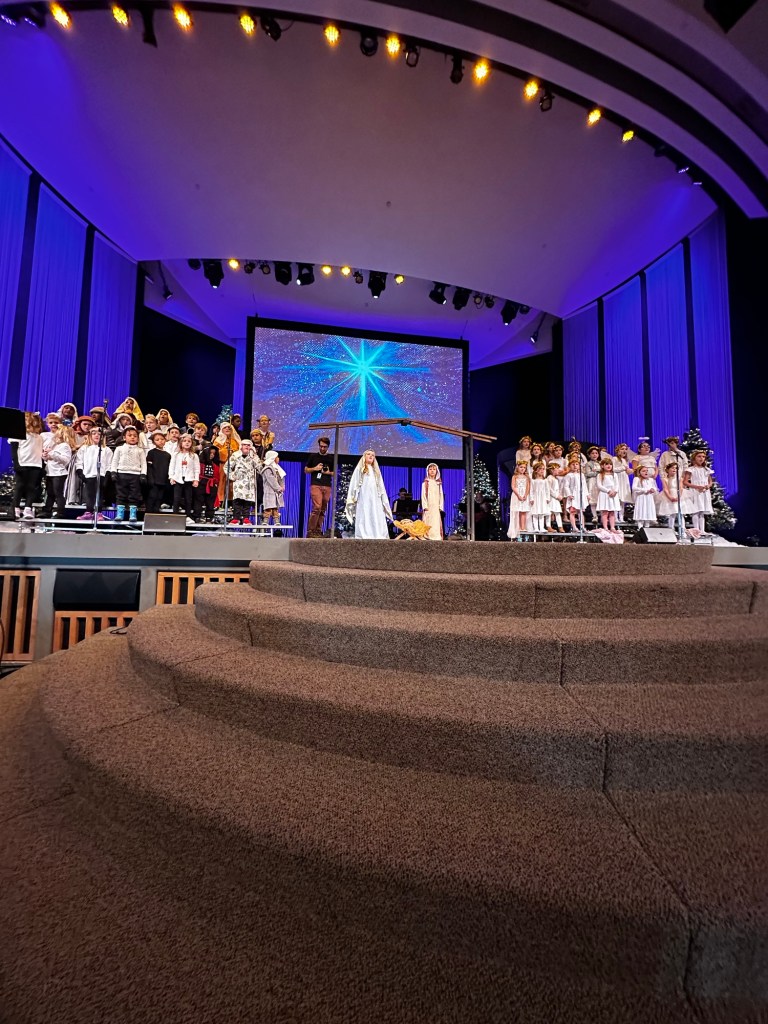
The littlest shepherd in the front row tilted his head as his pillowcase head covering fell over his eyes…again. Angels in garland halos sang while a 5 year-old Mary carefully rocked the Jesus doll. It was a chaotic, adorable scene, and the congregation was delighted.
I sat on the floor in the front row, trying to help the kids with their cues. When the song “Away in a Manger” came on, however, a familiar line removed me from the moment:
“The little Lord Jesus, no crying he makes.”
Really? The baby Jesus didn’t cry? Whoever wrote this poem must have never flown in economy. There’s an implication that comes with this idea that the baby Jesus didn’t cry—that Jesus wasn’t totally human. And while I’m sure the author was just trying to complete the rhyme, it makes me wonder how it affects us when we forget the humanity of Jesus.
Credits go to Pastor Rene for capturing myself, Elizabeth, and Yolanda all trying to get the kids to smile, sing, and stop whacking each other with their shepherd’s crooks.
There’s a name for this doctrine: the hypostatic union, which describes the dual nature of Christ. It means Jesus was both fully God and fully man.
This doctrine doesn’t simply make me feel better about myself in that, in my humanity I have put myself closer to Jesus. It means that He has intentionally, and at great cost to himself, put himself closer to me.
It means that when I was highlighting scripts for the narrators an hour before the Christmas Pageant started, crying behind a music stand because my mom has a terrible disease I cannot heal, Jesus was close to me.
The truth is that Little Lord Jesus did not stay little. He grew. He became a man called the “man of sorrows” and one “well acquainted with grief” (Isaiah 53:3). In taking on humanity, Jesus did not save himself from suffering. He didn’t rescue himself from the cross, but went there willingly out of love for us. For you.
Glossy images of a soundly sleeping baby in a serene stable (it was most likely a cave) probably do not accurately depict the first Christmas, and thank God! The scene of the first Christmas was more than likely a mess, much like the world Jesus entered into to redeem.
So to you who shed tears this year, remember Jesus, both in the manger and on the cross. The God-man who wept understands and stays near (Hebrews 4:15). He has given the ultimate gift. And one day, when we are fully in his embrace again, we won’t cry anymore (Revelation 21:4).
When I was small, my Nana sometimes watched me for my mom when she was still working in the makeup world. Life was magic when we were together because Nana held her own special kind of magic. A talented artist, she could draw or paint anything I asked with perfect accuracy (she still can). If I asked for a story, she could weave one together on the spot and go on for hours. Nana liked to put me down for my nap listening to a French language tape so I would one day wake up fluent, or at least able to say, “Je suis fatigue, grand-mère.”
But her favorite thing to do was teach me poems. And she knew hundreds of them by heart. My favorite was one about the changing of the seasons:
“Come, little leaves,” said the wind one day, “Come o’er the meadows with me and play; Put on your dresses of red and gold, For summer is gone and the days grow cold.”
Soon as the leaves heard the wind’s loud call, Down they came fluttering, one and all; Over the brown fields they danced and flew, singing the glad little songs they knew.
“Cricket, goodbye, we’ve been friends so long; Little brook, sing us your farewell song; Say you are sorry to see us go; Ah, you will miss us, right well we know.
“Dear little lambs in your fleecy fold, Mother will keep you from harm and cold; fondly we watched you in vale and glade; Say, will you dream of our loving shade?”
Dancing and whirling, the little leaves went; Winter had called them, and they were content; soon, fast asleep in their earthy beds, The snow laid a coverlid over their heads.
(“Come Little Leaves” by George Cooper)
A few of the lines are different than I remember them, but the image of leaves being tucked in, just like Nana would swaddle me in her lap, has stuck with me for years. We learned dozens of poems but this one in particular gave me comfort whenever I missed her. I loved the idea of the leaves at rest, contently sleeping in the snow which ultimately signaled the end of their season.
Rest. Contentment. Sleep. I associate these words with the Christmas and New Year’s season, but how seldom I actually obtain them. For teachers, Christmas break is like a far-off lighthouse we seek in the fog and grog of the late Autumn months. Sleepy midnight grading sessions give way to sleepy mornings, and evening (4:45pm where I live) creeps in so early, it’s tempting to go to bed before dinner.
I admit that I have sought Christmas break as my sole opportunity for rest, especially this year. I have been restless in body and soul, so in need of a good hug from Nana and maybe a nap to a French phrases tape.
Rest, I think, is somewhat connected to the concept of contentment. All December, until my last grade is submitted, I find myself talking about how everything will be okay when—fill in the blank with “when break starts” or “when I can sleep in later than 6:00.” My rest, my contentment, becomes dependent on how much work I have to do on the weekend, or how much sleep I’m getting. Pretty unsustainable, right?
But scripture offers a better way.
Take one of Paul’s many stints in a Roman prison where he boasted of his contentment, for example:
“I rejoiced greatly in the Lord that at last you renewed your concern for me. Indeed, you were concerned, but you had no opportunity to show it. I am not saying this because I am in need, for I have learned to be content whatever the circumstances. I know what it is to be in need, and I know what it is to have plenty. I have learned the secret of being content in any and every situation, whether well fed or hungry, whether living in plenty or in want. I can do all this through him who gives me strength.”
Philippians 4:10-13
I often think of Paul as some sort of superhuman, but in the same way that I have all the same hours in the day as Beyoncé (I saw that on a mug once) we have all the same tools Paul had to work with. Roman prisons weren’t cushy places. They were cold and dark, and your only hope of food or care was for someone in the outside world to remember you. There were plenty of reasons to complain. I’m sure Paul felt them just as we all would. But the deep truth lodged in his heart kept him from wavering from the truth that even in prison, he was still held by the hand of a very present God. This truth did not make the drafty prison any warmer or his situation any less deadly, but the knowledge of a heavenly world beyond the prison walls did keep his heart secure.
So, how do we learn to rest in that same knowledge? For me, repetition is helpful. It’s why a handwritten Psalm 40 is taped beside my bathroom mirror. On days when I feel like I can’t grade one more essay or manage one more headache, my heart and mind need to say with the Psalmist,
I waited patiently for the Lord; he turned to me and heard my cry. He lifted me out of the slimy pit, out of the mud and mire; he set my feet on a rock and gave me a firm place to stand. He put a new song in my mouth, a hymn of praise to our God. Many will see and fear the Lord and put their trust in him.
Psalm 40:1-3
I started attempting to memorize this Psalm last month when waves of anxiety and migraine pain were unwelcome but constant companions. I woke at 3am one night, tangled in my covers and afraid. The Bible app on my phone shone brightly as I searched the concordance for verses. Psalm 40 was on my screen and tears filled my eyes. Suddenly, a song I learned in my college choir came into my head:
I waited for the Lord. He inclined unto me. He heard my complaint. He heard my complaint. (Here’s a link if you want to listen to it.)
Mendelssohn’s emotional hymn which captured my heart 7 years ago once again rang through my heart, burying my anxious thoughts like leaves tucked soundlessly beneath a blanket of snow. God hears me. He has a plan for me. A plan to one day take me home to be with him forever. It’s why he came to earth at great personal cost–really, the greatest cost of all, because he heard humanity’s cry and responded.
Victory in the Christian life cannot be measured by any level of comfort or success simply because by those standards, Jesus lost. Born to poor parents and crucified like a criminal, Jesus was the poster child for contentment in unfavorable and immovable circumstances. Scripture tells us that he persevered, not through a change in circumstances, but by remembering “the joy set before him” (Hebrews 12:2).
Brokenness is a reality of this world. But the God who restores is still present in it. He is not afraid. He is not surprised. A professor whose lecture I recently watched at a conference reminded me that God is not passive to evil in the world, but actively fighting it–the chief piece of evidence being the Cross, which cost him everything.
That God, not our circumstances, is where we find deep rest. That God, who bends down to listen when we pray (Psalm 116:2) is a safe harbor, our lighthouse in the darkness and the chill. He is our covering of snow, and we can rest in Him in every season.






 Kayley Chartier