We’re not Lost

In the quiet of the morning I take my coffee and park, as I have since I can remember, on the stairs overlooking the living room. Red and green light flashes softly from the scraggly tree in the corner, illuminating the two dozen snowflakes that hover over the room, suspended in their fall by navy blue thread.

To be honest, Christmas crept up on me this year—what with new pandemic regulations restricting many of the traditions I usually use to mark our progress through the season. (Particularly missing Streets of Bethlehem: a live nativity-meets-market that tells the Christmas story with costumed vendors inviting guests to make their own spice blends, spin wool, eat flatbread, and watch a teenage Mary and Joseph try to find a place to stay. It’s amazing.)

Not only that, but the flurry of Dead Week and Finals, moving from in-person classes to Zoom right before breaking for Christmas was NUTS. I don’t think I’ve ever had more emails in my inbox at a time.

And yet, there’s this shining moment of peace with my coffee and my cat and at least a few more minutes of dark before I make myself go out and run.

You don’t need me to tell you that this year has been a trip right from the start. My own pandemic experience was unique in that I went through my first breakup just days before lockdown, which was honestly great timing because no one really questioned why I was staying home! God was so gentle with me in those months, bringing so much hope and healing with the promise of something new.

My chicken coop was very symbolic of that period. The old coop we used as a foundation was a lost cause. And yet, we took something pretty beat up and made it into something beautiful. Even the timing of it was symbolic. It took months to build, and by the time I was finishing up with the paint, the sweet boy who fixed my computer and helped me hand out groceries to the needy was calling me on the phone. We spent those early months talking books and travel and about our faith and really becoming friends. In the year that everyone is calling “lost,” I found him—the kindest heart I have ever known. I’m sure glad those moments weren’t lost on me.

Then there was finishing my Master’s, which was no small feat. To all of you who have spent the last 6 months complaining about Zoom school, try doing 15 grad classes with zero lectures, a million books to read, oh! And each class is five weeks long with no breaks in between. I didn’t have the Colorado mountain-graduation I was expecting, but I did walk away with a sense of accomplishment I was afraid I’d miss out on by doing school online.

Studying the Bible in depth deepened both my appreciation for the scriptures as well as my faith. That wasn’t lost on me.

Then there was teaching English for the first time, which honestly felt like running on a treadmill that’s floating down a river on a pallet. Four grades, three courses, a million and one lessons learned. I’m so grateful for the opportunity, not only to teach works I’ve studied and loved, but also to connect with students in a year they’ll remember forever: a year people will try to tell them didn’t matter. It’s been encouraging me to tell them with all the joy and conviction in my heart that this moment DOES matter because God is still working when they can’t see it. That was not lost on me.
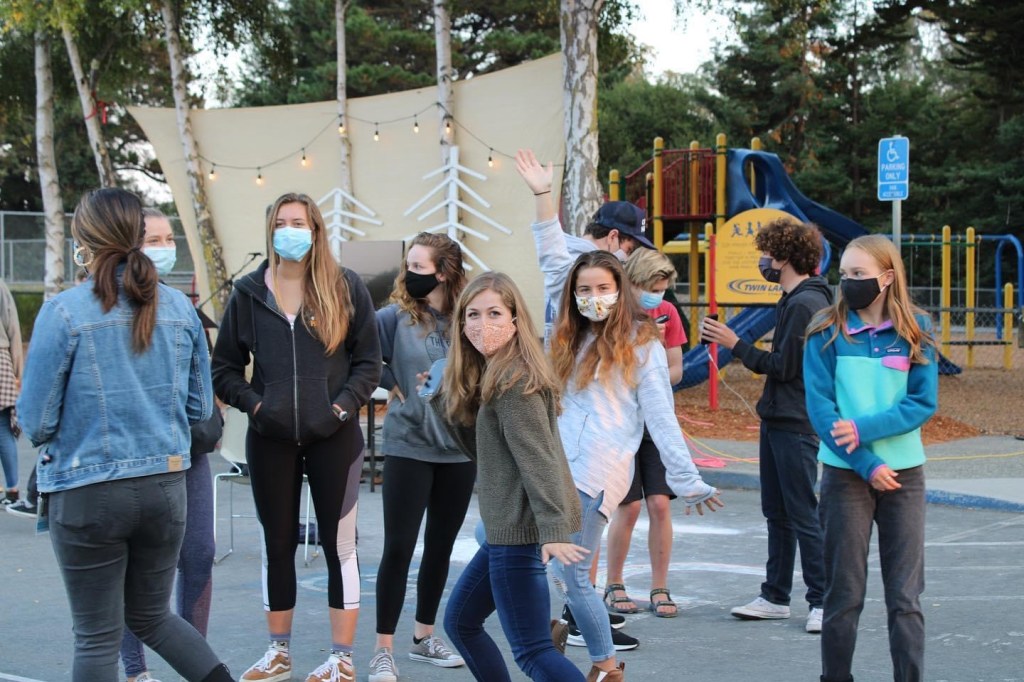
Neither was praying with students at youth group after we discussed their very hard, very real questions—nor was the opportunity to even be meeting IN PERSON with students every week, playing, encouraging, and worshipping alongside them.
Nor was dancing in the light of the Intern House Christmas tree after my love put together a day of cheesy Christmas things I’ll remember forever.


Nor is sitting at the table with my grandparents eating French toast.

Each year presents an equal opportunity to get lost, or to get lost in God. Six years ago I started reading Genesis with the knowledge that the same God who guided Abraham into the wilderness could also walk with me into the unknowns of January, and each January after that. I haven’t been the same since.

I’m not naturally good at living in the moment, but perhaps this slower year has taught me how. I think it starts with acknowledging God’s character: his steadfastness, his mercy when we’re hardheaded, his ability to counsel, comfort, and guide and bless beyond what we could ever dream. That knowledge gives way to gratitude, which I’m realizing is the real secret to contentment even in a crap year. I can *actually* stand with Paul and be content, not on my own strength but in the strength of the Lord:

“I know what it is to be in need, and I know what it is to have plenty. I have learned the secret of being content in any and every situation, whether well fed or hungry, whether living in plenty or in want. I can do all this through him who gives me strength.”

Philippians 4:12-13

In 2020, and even in 2021, we’re not lost when His many gifts are not lost on us.

Merry Christmas and wishing you the blessing of a deeper relationship with Him in the New Year,

Kayley

The Thorn in the Side of my Head

I always thought it ironic that I quit eating cheese two months before I went to Paris for my 16th birthday. Cheese was like, a Paris thing, and yet I found myself refusing it the whole two weeks were were there.

“Je voudrais une soupe à l’oignon…no gratin?” The waiter stared at me, confused.

“No… gratin?” he repeated.

“No fromage, s’il vous plaît?” I asked sheepishly.

With a week of reading from my French translation book and a handful of lessons from my Nana as a child, I wasn’t sure how to say what I really meant which was somewhere along the lines of, ” Look. I can’t do the cheese on top, even though I really want it, because it will give me a headache–and then again, everything these days gives me a headache. And I’m just really tired and feel really helpless that my head won’t stop hurting, and I can’t find my translation book, but I’m doing my best here, so may I please have the onion soup without the grated cheese on top? Thank you.” Insert giant shrug here.

The waiter nodded, still confused by my language, and walked off while I withdrew from the noise of the tourist-packed restaurant into the uncertain future I was conjuring in my mind.

A few years later, I would sit at my kitchen table across from my dad, tears soaking my unfinished Econ homework.

“I want to…hic…grow up…hic…and get married and live my life and…and…who would want to be with someone with..hic…CHRONIC HEADACHES?”

I sobbed and sobbed while my poor dad tried his best to make out my words. The tears were rolling fast, falling from the place where pent up frustration with not being “normal” was kept. My dad understood. I was in high school and wanted to hang out with friends without having to go home early because I forgot to bring Tylenol. I wanted to stop living with the fear of brain tumors, or of dying alone because no one could want a girl who, God forbid, had to take naps once in a while. (That last fear screams teenage angst and I laugh as I remember this being a very real, high-priority concern of sixteen year-old me).

Two years later was my worst summer. It started with a CT scan to see if I had a brain tumor, followed by bloodwork, a largely inconclusive allergy test, and the recommendation from a doctor that I should see a neurologist.

The chronic headaches began when I was 16. I am now on the edge of 24. I write this from my back porch, wrapped in a blanket against the late spring chill with the familiar, slow throb of pain in my head. What’s different now is that I no longer curse it. I’ve learned to find the beauty that lies behind this thorn.

Grace for Dummies

In 2 Corinthians 12, Paul describes the “thorn” of the enemy that taunts him. I’ve always thought it interesting that Paul did not do us the pleasure of disclosing what that thorn actually was.

Was it jealousy?

Lust?

Did Paul suffer from a chronic illness?

Even the best Pauline scholars are left scratching their heads with the rest of us. What we know is that this thorn caused Paul torment, and though he fervently asked God to remove it three times, the Lord allowed it to remain. Paul wanted to be free from this burden. God had a different plan:

“Three times I pleaded with the Lord to take it away from me. But he said to me, “My grace is sufficient for you, for my power is made perfect in weakness.” 

2 Corinthians 12:8-9a

How’s that for an answer? Paul had a chronic thorn he wanted to be rid of. Instead of removing it, the Lord pointed at the very thing he despised and called it grace.

This isn’t the first time God uses weakness to put his strength on display. In fact, it seems to be one of the Lord’s favorite pastimes to use the broken to show his glory (1 Corinthians 1:27). The Bible is absolutely littered with these glorious images of ineptitude:

Sara was too old to give birth (Genesis 18:10-14).

Moses had a stutter (Exodus 4:10).

Hannah was barren (1 Samuel 1:6-20).

David was an adulterer and murderer (2 Samuel 12:6-12).

Isaiah had unclean lips (Isaiah 6:5-7).

Peter denied he even knew Jesus (Luke 22:61-62).

In every story, God used human weakness to reveal His strength. Moses could’ve been born a perfect orator–but what opportunity would that be to reveal the Lord’s power to Pharaoh? And what opportunity would that have given Moses to rely on the Lord?


Lord of the Lonely

As far as “thorns” go, headaches are strange. Unlike a broken leg, which will always garner special treatment, the headache (like mental illness or any other chronic disease) remains the ever-invisible injury. Everyone wants to sign your cast, but no one will ever sign “get well soon” on your temple in the middle of a migraine.

Thus, it’s a lonely experience. Luckily, the Lord knows Lonely. A man of sorrows and well-acquainted with grief, Jesus is very familiar with suffering solo (read Isaiah 53).

During his earthly ministry, Jesus beautifully comes alongside the lonely and suffering, often defying Jewish custom and angering the local clergy in order to heal them. For instance, the Woman with the Issue of Blood (read Mark 5:25-34.). In Jewish culture and under the Law of Moses purity was paramount. Touching blood made one ceremonially unclean–therefore women were considered “unclean” for at least a few days out of every month.

Now picture a woman who had been unclean, unnoticed, untouched, and uncomforted–not for days, but for twelve years. After spending all she owned on doctors who could not stop the hemorrhaging, she turned to Jesus for healing. Reaching for the back of his cloak, she gave a gentle tug. Surely the Rabbi would not notice her, not with the sea of people surrounding him.

And yet, when the woman touches Jesus, it is faith and her desperate touch, not the brush of the crowds around him, that captures his attention. Jesus turns and she is caught in his gaze. She comes away completely healed because of her faith.

Sanctification through Suffering

Perhaps one day, I will wake up headache free and never have to take a single capsule of ibuprofen again. I fully believe the Lord could heal me in an instant if that as His will, just like the woman in Mark 5.

But what if he does not take our thorns in this life? What then? This Charles Spurgeon quote has always brought comfort to my soul:

“I have learned to kiss the waves that throw me up against the Rock of Ages.”

It is man’s natural inclination to pursue pleasure and avoid pain, but the Cruciform life turns that worldly paradigm on its head. Just as Christ suffered for the joy that was set before him, we endure trials with the knowledge that they produce in us something of Heaven. In the paradoxical ways of the Kingdom, no one can truly live until they die (John 2:24).

Even if the healing does not come in this life, I have faith that something else–something of eternal significance– is being produced, coming up like a daffodil after the frost.

Paul finishes his thorn-account with this encouragement:

“Therefore I will boast all the more gladly about my weaknesses, so that Christ’s power may rest on me. That is why, for Christ’s sake, I delight in weaknesses, in insults, in hardships, in persecutions, in difficulties. For when I am weak, then I am strong.”

2 Corinthians 12:9b-10
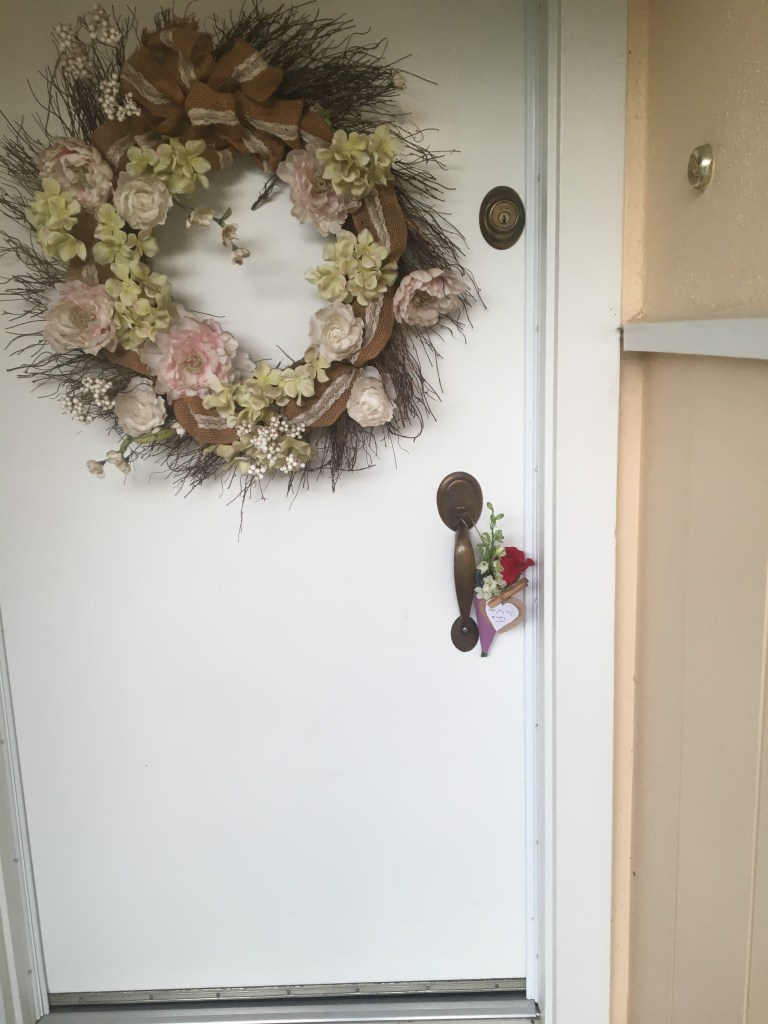
A little May Day surprise I left for an elderly neighbor a few weeks ago.
Through my chronic pain, the Lord has cultivated in me compassion for the lonely.

My headaches have brought me to my knees more times than I can count, but I no longer curse them.

In moments of praying desperately that I won’t explode at the person who happens to be bothering me while I’m in the middle of particularly bad episode, I have felt his hand on my shoulder reminding me to give them grace.

In the long, sleepless nights when the Tylenol, steam shower, and peppermint oil just aren’t cutting it, I know He is there to comfort me through the pain.

I may not be healed in this lifetime. Is God still good? Absolutely. His Word and His Spirit, and the work of Jesus on the cross reveal both His character, and his will for my life here and in Heaven.

And as I walk through this life bearing this thorn, I can trust that Jesus is also bearing me up, pouring out grace and strength for my weakness as He teaches me to follow him.