God is not a man named Max who owns a garden store: on Ricky Bobby, G.K. Chesterton, and the gospel of Burger King

So… what’s up with this title?

I wish I knew the original thought behind it. Sometimes I wake up abruptly in the night with an idea that just MUST be recorded and, well, this was one of my recents.
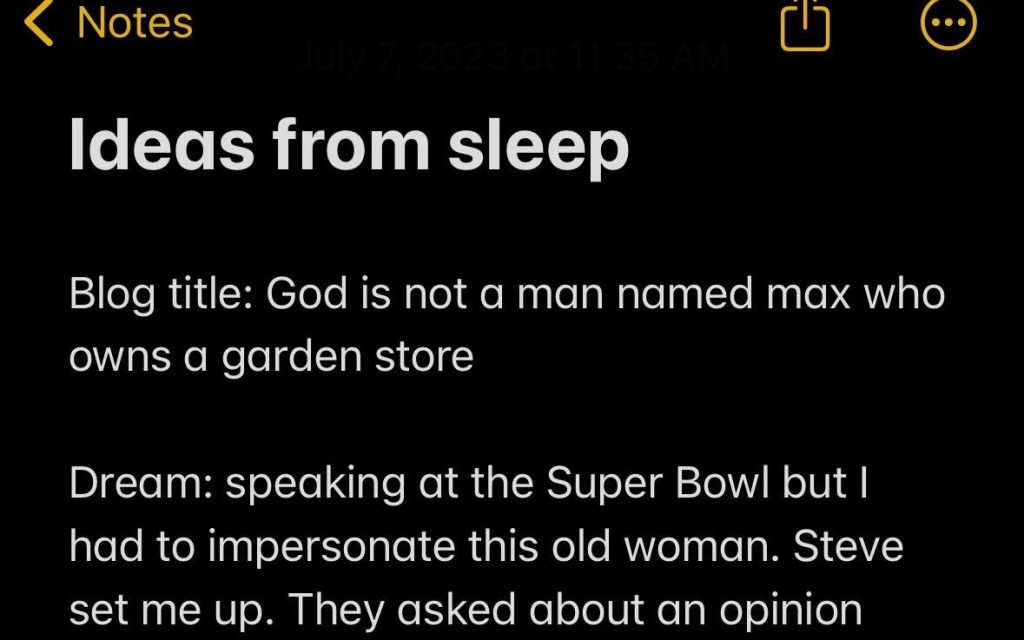
There was also an elaborate dream about being a speaker at the Super Bowl, which should tell you how much my subconscious mind knows about the Super Bowl.

Despite being the product of 2am brain waves, I do think I can take a guess at where I was going with this. Perhaps my subconscious was picking up on something my brain has been processing lately: the nature and character of God.

I live in America: land of the free, home of the brave, but I must acknowledge that it is also the land of the Super-Walmart and the Big Gulp. Though I am grateful for the opportunity and freedom to make my life what I want it to be, I can’t apply that same “Have it Your Way” mentality to God and expect his character to be just as it is represented in the scriptures.

So basically, God can’t be whoever I want him to be and still be God.

Cradle to Cross

I first came to grips with this idea when I was preparing for the first-ever message I gave in a church. My pastor asked if I would give a short Christmas teaching and I, halfway through my Bible degree, was incredibly excited to share some of what I had learned. My message, titled “From the Cradle to the Cross” discussed the incomplete picture of Christ which results from keeping our ideas of Jesus limited to the tiny, helpless baby lying in the manger.

In the movie Talladega Nights, Ricky Bobby announces that he prefers to pray to Baby Jesus.

Jesus “meek and mild”

G.K. Chesterton wrote about this concept in The Everlasting Man, explaining how the picture of “Gentle Jesus, meek and mild” is an incomplete image. In a passage I find slightly humorous, but not the least bit untrue, Chesterton writes,

“If there is one aspect of the New Testament Jesus in which he may be said to present himself eminently as a practical person, it is in the aspect of an exorcist. There is nothing meek and mild, there is nothing even in the ordinary sense mystical, about the tone of the voice that says ​‘Hold thy peace and come out of him.’ It is much more like the tone of a very business-like lion-tamer or a strong-minded doctor dealing with a homicidal maniac. But this is only a side issue for the sake of illustration; I am not now raising these controversies; but considering the case of the imaginary man from the moon to whom the New Testament is new.”

The idea that Jesus is meek is not untrue, but it’s not a wholistic picture. Jesus, the very image of God the Father (John 14:8-9) cannot merely be meek if he is to be Savior. Ricky Bobby in Talladega Nights might have liked the “eight-pound six ounce, newborn infant Jesus,” but we need the wholistic picture for God to really be God.

Don’t worship a guy named Max who owns a garden store

Back to that ridiculous but apt title.

My natural flesh-self (which always gravitates toward the path of least resistance) does not like the Jesus who asks me to submit to anyone’s will but my own. If I’m not paying attention to how God reveals his character to his children, I might invent a god.

The god of my invention likes who I like and hates who I hate.

He always agrees with me.

He is always “loving,” never convicts or corrects me, and doesn’t make me feel bad.

The god I invent most definitely would never ask me to do something I don’t want to do.

The god of my creation might as well be a guy named Max who owns a garden store: unoffensive, stays out of my business, nice. But this god is also powerless to change me, heal me, and save me. The god I invent is full of “grace,” but not truth. On other days, I might invent a god who is all about “truth” (read: very angry at me and everyone) but lacks the grace we see the true God bestowing all over scripture.

Sorry, Max.

If I am to follow the true God, I need to submit myself to all of him: all of his titles and character traits He himself has revealed through Scripture; to all of His sides and colors and flavors and fragrances, not just the ones I prefer. And the thing is, I actually want Him more, the real, true God. At least I do when I taste and see that He actually is as good as He says He is (Psalm 34:8).

In my eight years of reborn-ness, I have only just begun to dive into the mystery of the true God– the one who is better than anything I could make up. I know Him now to be the one who has healed my mother’s sickness and healed my heart of so much bitterness and fear.

When I was going through a breakup a few years ago, I begged God to remove my pain with a sort of spiritual codeine, but He didn’t. I didn’t get that for a bit. All I wanted to was bargain and moan and be numbed because I felt like my heart was split in two. There were some very tender moments in that season where I would cry out to Him, usually after reading in the Psalms, and though I still felt the pain, I could also feel Him coming close to me and feeling it with me. It was consistent with his character– how He sent Jesus in the form of man, not only to heal us and forgive us of our sins, but also to be WITH us. The God who does that… that’s a God I want to serve.

The closest thing to a “garden store” near me is the farm stand about a mile down the road from me.

For reasons unknown to me, the Lord may not remove every obstacle in my path, and I can trust Him even so because He has proven himself to be trustworthy, faithful, and true. He has named himself Abba (Father; Gal. 4:6), Shalom (Peace, Judges 6:24), Rapha (Healer, Exodus 15:26), and Jireh (Provider, Gen. 22:14). I may not know the depths of each of those names or characteristics yet, but I know they all describe the same God who somehow desires that I know Him.

It reminds me of when Mr. Beaver speaks to Lucy about Aslan in The Lion, the Witch, and the Wardrobe. “He’s not safe,” he says. “Who said anything about safe? ‘Course he isn’t safe. But he’s good. He’s the King, I tell you.”
For the Beauty

For the Beauty of the Earth,

For the glory of the skies,

For the love which from our birth

Over and around us lies.

Lord of all to thee we raise

This, our hymn of grateful praise.

Elliot Sanford Pierpont

I’ve been sitting on this blog post for a week, terrified that I was not speaking truthfully. I started out writing about birds–about the surprise of finding forgotten or overlooked beauty and delighting in the Creator of it. I do think what I was writing was true, but I was in conflict with my own heart as it grieved. Now I think I’ve got it right.

I am a self-proclaimed beauty-seeker. The tagline for this very website is something that became sort of a motto for myself as I began writing in college: Found in Christ, Finding Him in everything. It truly is my heart’s cry. I see the Lord in the vineyards around my neighborhood and remember Jesus as the True Vine. I see Jesus when I throw together the three meager ingredients of flour, salt, and water and watch as they turn into bread that will sustain. My day is filled with prayers as I expectantly wait to see Jesus in everything.

And I usually do.

But this year, it’s been particularly difficult.

When life is not beautiful

The hard part of becoming a beauty-seeker is balancing hope with the present reality. It’s seeking the glimpses of Heaven, yet never painting the brokenness of the world to be what it actually isn’t. I’ve learned this this year after losing three friends who were like family. One I found out about only a week ago.

Death is disturbing, not beautiful. I don’t care how many times Disney tries to reframe it: death in and of itself is not beautiful. We who are too used to the world’s patterns of shatteredness will rationalize it as “natural” and “part of life,” but it’s flat not. Death was never God’s perfect plan for humanity, and I think accepting that theological reality is a necessary part of grieving well. The wrong-ness of death is why Jesus, just moments from pulling him from a grave didn’t just stand dry-eyed when his friend Lazarus died. He wept (John 11:35).

I knew these things, yet through all three losses, I was tempted to beautify death– to offer platitudes to grieving people in the name of comfort because I felt responsible to make things okay. And to be completely honest, I didn’t trust that God was interested in doing that.

All the sad things untrue

Recently I was listening to a podcast on anxiety that stopped me in my tracks. Speaking about his book The Anxiety Opportunity, author and theologian at Duke Divinity school, Curtis Chang explained that while anxiety is the fear of loss, the hope of the Resurrection in Jesus Christ makes it possible for one to endure anxiety because it ensures that all loss will be restored:

“He will wipe away every tear from their eyes, and death shall be no more, neither shall there be mourning, nor crying, nor pain anymore, for the former things have passed away.” (Revelation 21:4)

Though the conversation focused on anxiety and not death, I found this point to be the very thing my heart needed to honestly grieve death before the Lord.

He shall restore.

The resurrection is the answer to death because Jesus’ victory is the death of death. Do you see how much emotional and psychological freedom comes from this truth? In the light of the Resurrection, we are free to let the losses truly be losses because we know a God who will restore.

In the light of the Resurrection, we are free to let the losses truly be losses because we know a God who will restore.

The Christian life does not guarantee the prevention of loss. It guarantees it (John 16:33). And some things will simply not be become fully beautiful in this life. Some people won’t get healed. The glimpses of glory and beauty we get in this life are all sweet visions of what await, but saying that everything will be beautiful in this life is misleading.

But God. How often I forget that it will be worth the wait to see what He is preparing for us. Sin wrecked this world bad, but the cross was an offensive move that tore apart every barrier standing between the King and his people. Jesus is not standing passively by in our pain. Just as God heard Israel’s cries from slavery, he will redeem us from the pain, the ultimate being separation from Him. The cross that cost him so much reminds us of the ugliness of death, but the empty tomb reminds us that God restores everything in the end.

This is no empty promise, no flimsy sales pitch, no bait and switch. It is something strong I can lean on even as I weep.

We can grieve fully because we know that the Beautiful Savior will restore everything to beauty once more.

January:

I like the idea of recapping the months because my brain is like the bottom of my purse and if I don’t clean it out every so often, I’m going to forget the something important buried at the bottom. (Most of the time it’s mints!)

January started out stormy. We were supposed to have a night out for NYE but spent it half asleep on the couch due to excessive rain. A week later, we were celebrating our first anniversary!

I will probably write all of my thoughts about that another time since I cannot seem to gather them (it’s always hardest to write about the people we love the most) but I will say that watching your wedding slideshow with your year-old frozen cake in one hand and your beloved’s hand in the other is a great way to end up joyful and tearful at only ten o’clock in the morning. We went on a little run around the Nisene forest during a break in the rain and just enjoyed each other’s company. It was such a gift.

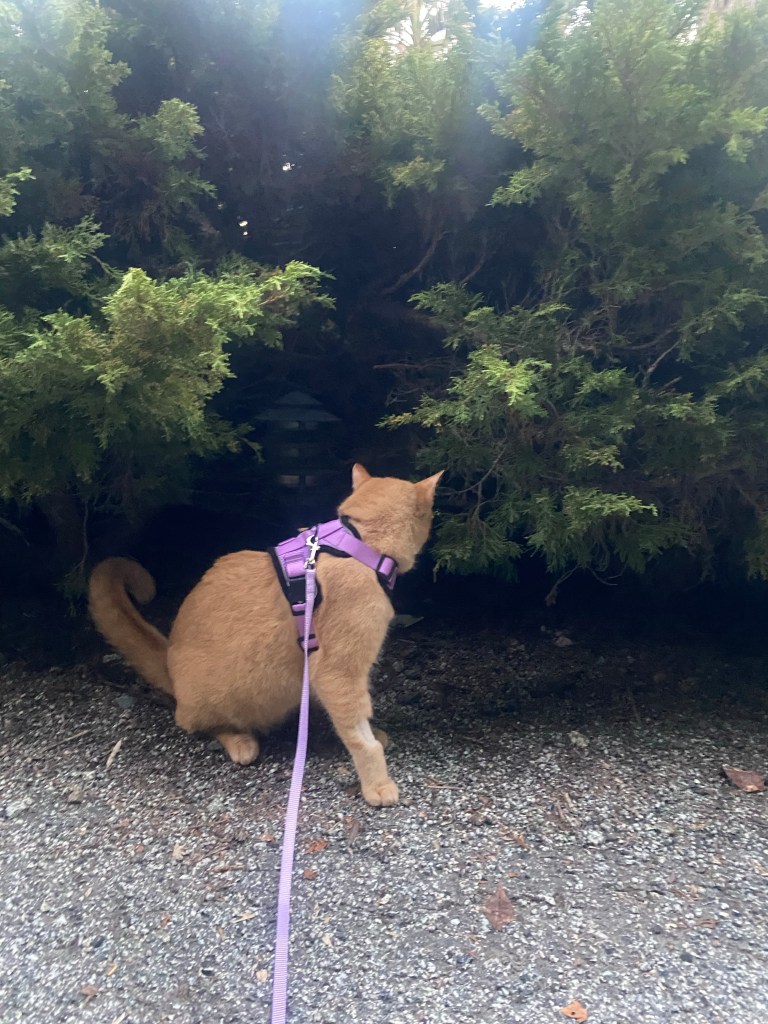
Speaking of gifts, Calvin got me a sweetest, most chaotic present I think anyone has ever been given! Two mornings before our anniversary, he ran out to the car at 6am to retrieve what he said was part one of my present and insisted that I open it. It was a cat harness! His plan was to begin the search for a cat right after I got off from work that day. While that didn’t end up happening until the next day, it was still so sweet and exciting that I had trouble focusing at work! His present totally beat the tent I got him.

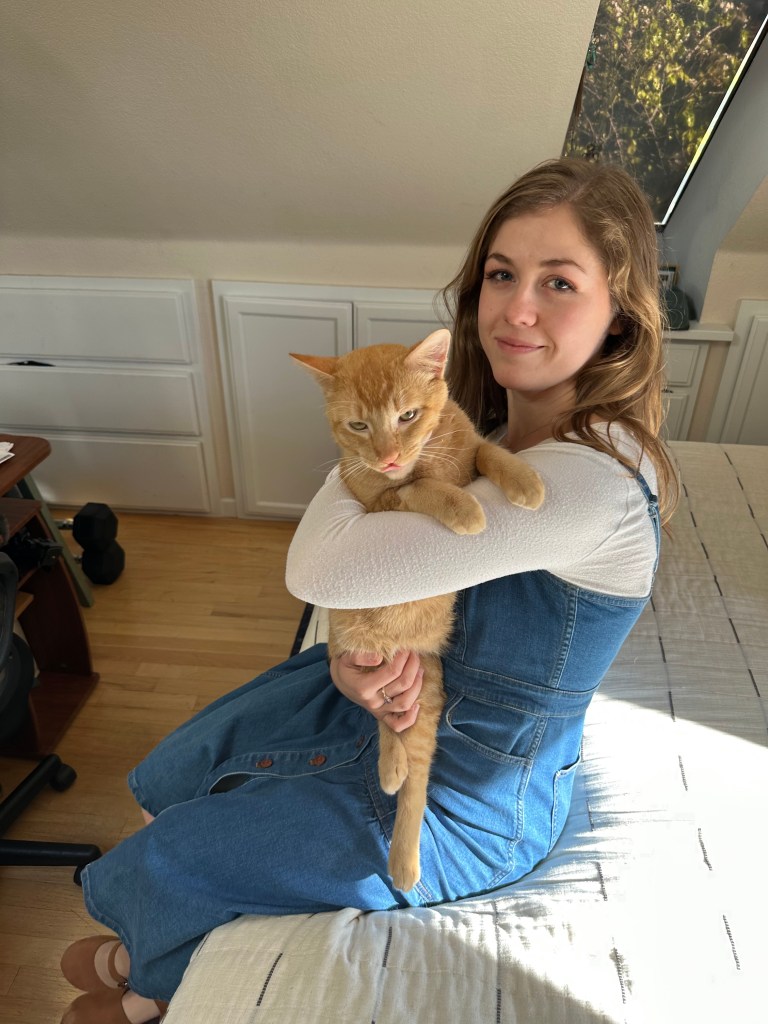
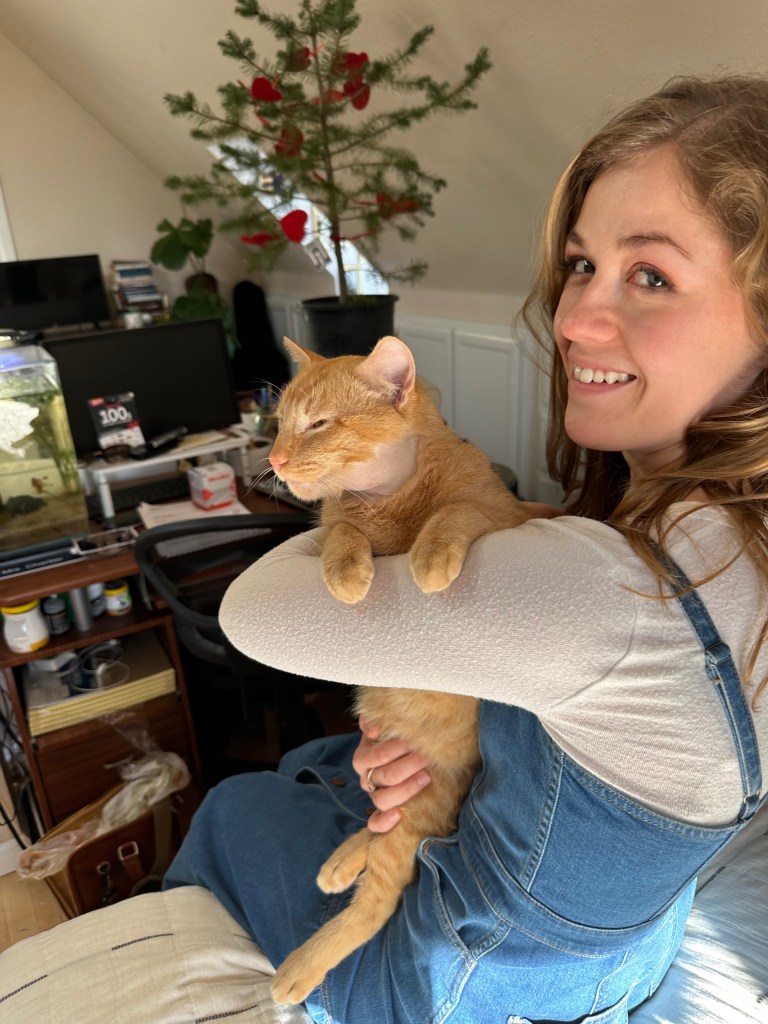
Anyway, that’s how we ended up with Liam. Sweet, chaotic, funny little Liam. His full name is actually Liam Neeson, which I am now seeing as prophetic, seeing how all of my food and Calvin’s ends up Taken if we’re not guarding it. He’s a troublemaker and he wakes me up a lot at night, but at least he’s very cute.

And as January gives way to February, I feel like my life is becoming different and completely new (or maybe it’s just the lack of sleep. Thanks, Liam!). In two weeks, Calvin will begin training to be an EMT and with him gone at night, I will have my first taste of what it’s like to be a firefighter’s wife.

Oh yeah—Calvin wants to be a firefighter now!

I have had trouble with sleeping since I was a kid. I am prone to bad dreams and night terrors and I rarely sleep well alone. When I was younger and living at home, I began playing Christian music radio while I slept so that my anxious mind would be filled with good things if and when I woke in the night. I guess I could do that, but I’d rather just not have the sleep anxiety to begin with.

The thought of sleeping alone again is something I am continually laying at Jesus’ feet because frankly, I just don’t know how I’m going to do it. Firefighters typically work for two days and are off for four, but even one night alone is hard for me. I guess that is why the Scriptures are so full of assurances of God’s strength when we are weak:

“But he said to me, “My grace is sufficient for you, for my power is made perfect in weakness.” Therefore I will boast all the more gladly of my weaknesses, so that the power of Christ may rest upon me*.” (2 Corinthians 12:9)

The Lord is my strength* and my song, and he has become my salvation; this is my God, and I will praise him, my father’s God, and I will exalt him.” (Exodus 15:2)

“But they who wait for the Lord shall renew their strength*; they shall mount up with wings like eagles; they shall run and not be weary; they shall walk and not faint.” (Isaiah 40:31)

*emphasis mine

I guess what I’m learning is that hard situations like this are to be embraced, not feared, because they reveal the important reality that I am not strong. He is. I love the truth of Isaiah 40:31 because it reminds me that the strength comes from waiting on the Lord. He is able to make me into anything he wants me to be, but it is not up to me to muster up my strength on my own.

I guess what I’m learning is that hard situations like this are to be embraced, not feared, because they reveal the important reality that I am not strong.

Kayley Chartier

New marriage becoming older and sweeter by the day, new cat, new job, new month, same God. Same promises in His word to abide in me as I abide in Him. He is walking with me ( and you!) into February like a close friend we need only call to.

One more thing! This month I started reading through the Gospels using the Annie F. Downs reading plan (you can find it here, or tune in on her podcast, Let’s Read the Gospels) and it has been such a blessing to me. Waking up each morning knowing that I would be hearing about the life of Jesus and the teachings of Jesus and the heart of Jesus filled me with joy and peace in a season where the 4 hours of sleep and the cat litter once-again spilled threatened to steal it. I hope you’ll join me in February! If you do, leave a comment and let me know so I can be praying for you!

Love,

Kayley

A Blanket of Snow

When I was small, my Nana sometimes watched me for my mom when she was still working in the makeup world. Life was magic when we were together because Nana held her own special kind of magic. A talented artist, she could draw or paint anything I asked with perfect accuracy (she still can). If I asked for a story, she could weave one together on the spot and go on for hours. Nana liked to put me down for my nap listening to a French language tape so I would one day wake up fluent, or at least able to say, “Je suis fatigue, grand-mère.”

But her favorite thing to do was teach me poems. And she knew hundreds of them by heart. My favorite was one about the changing of the seasons:

“Come, little leaves,” said the wind one day,
“Come o’er the meadows with me and play;
Put on your dresses of red and gold,
For summer is gone and the days grow cold.”

Soon as the leaves heard the wind’s loud call,
Down they came fluttering, one and all;
Over the brown fields they danced and flew,
singing the glad little songs they knew.

“Cricket, goodbye, we’ve been friends so long;
Little brook, sing us your farewell song;
Say you are sorry to see us go;
Ah, you will miss us, right well we know.

“Dear little lambs in your fleecy fold,
Mother will keep you from harm and cold;
fondly we watched you in vale and glade;
Say, will you dream of our loving shade?”

Dancing and whirling, the little leaves went;

Winter had called them, and they were content;
soon, fast asleep in their earthy beds,
The snow laid a coverlid over their heads
.


(“Come Little Leaves” by George Cooper)

A few of the lines are different than I remember them, but the image of leaves being tucked in, just like Nana would swaddle me in her lap, has stuck with me for years. We learned dozens of poems but this one in particular gave me comfort whenever I missed her. I loved the idea of the leaves at rest, contently sleeping in the snow which ultimately signaled the end of their season.

Rest. Contentment. Sleep. I associate these words with the Christmas and New Year’s season, but how seldom I actually obtain them. For teachers, Christmas break is like a far-off lighthouse we seek in the fog and grog of the late Autumn months. Sleepy midnight grading sessions give way to sleepy mornings, and evening (4:45pm where I live) creeps in so early, it’s tempting to go to bed before dinner.

I admit that I have sought Christmas break as my sole opportunity for rest, especially this year. I have been restless in body and soul, so in need of a good hug from Nana and maybe a nap to a French phrases tape.

Rest, I think, is somewhat connected to the concept of contentment. All December, until my last grade is submitted, I find myself talking about how everything will be okay when—fill in the blank with “when break starts” or “when I can sleep in later than 6:00.” My rest, my contentment, becomes dependent on how much work I have to do on the weekend, or how much sleep I’m getting. Pretty unsustainable, right?

But scripture offers a better way.

Take one of Paul’s many stints in a Roman prison where he boasted of his contentment, for example:

 “I rejoiced greatly in the Lord that at last you renewed your concern for me. Indeed, you were concerned, but you had no opportunity to show it. I am not saying this because I am in need, for I have learned to be content whatever the circumstances. I know what it is to be in need, and I know what it is to have plenty. I have learned the secret of being content in any and every situation, whether well fed or hungry, whether living in plenty or in want. I can do all this through him who gives me strength.”

Philippians 4:10-13

I often think of Paul as some sort of superhuman, but in the same way that I have all the same hours in the day as Beyoncé (I saw that on a mug once) we have all the same tools Paul had to work with. Roman prisons weren’t cushy places. They were cold and dark, and your only hope of food or care was for someone in the outside world to remember you. There were plenty of reasons to complain. I’m sure Paul felt them just as we all would. But the deep truth lodged in his heart kept him from wavering from the truth that even in prison, he was still held by the hand of a very present God. This truth did not make the drafty prison any warmer or his situation any less deadly, but the knowledge of a heavenly world beyond the prison walls did keep his heart secure.

So, how do we learn to rest in that same knowledge? For me, repetition is helpful. It’s why a handwritten Psalm 40 is taped beside my bathroom mirror. On days when I feel like I can’t grade one more essay or manage one more headache, my heart and mind need to say with the Psalmist,

 I waited patiently for the Lord;
    he turned to me and heard my cry.
He lifted me out of the slimy pit,
    out of the mud and mire;
he set my feet on a rock
    and gave me a firm place to stand.
He put a new song in my mouth,
    a hymn of praise to our God.
Many will see and fear the Lord
    and put their trust in him.

Psalm 40:1-3

I started attempting to memorize this Psalm last month when waves of anxiety and migraine pain were unwelcome but constant companions. I woke at 3am one night, tangled in my covers and afraid. The Bible app on my phone shone brightly as I searched the concordance for verses. Psalm 40 was on my screen and tears filled my eyes. Suddenly, a song I learned in my college choir came into my head:

I waited for the Lord. He inclined unto me. He heard my complaint. He heard my complaint. (Here’s a link if you want to listen to it.)

Mendelssohn’s emotional hymn which captured my heart 7 years ago once again rang through my heart, burying my anxious thoughts like leaves tucked soundlessly beneath a blanket of snow. God hears me. He has a plan for me. A plan to one day take me home to be with him forever. It’s why he came to earth at great personal cost–really, the greatest cost of all, because he heard humanity’s cry and responded.

Victory in the Christian life cannot be measured by any level of comfort or success simply because by those standards, Jesus lost. Born to poor parents and crucified like a criminal, Jesus was the poster child for contentment in unfavorable and immovable circumstances. Scripture tells us that he persevered, not through a change in circumstances, but by remembering “the joy set before him” (Hebrews 12:2).

Brokenness is a reality of this world. But the God who restores is still present in it. He is not afraid. He is not surprised. A professor whose lecture I recently watched at a conference reminded me that God is not passive to evil in the world, but actively fighting it–the chief piece of evidence being the Cross, which cost him everything.

That God, not our circumstances, is where we find deep rest.
That God, who bends down to listen when we pray (Psalm 116:2) is a safe harbor, our lighthouse in the darkness and the chill.
He is our covering of snow, and we can rest in Him in every season.